
The Solution That Might Make the Problem Worse
This is the first article in a six-part series on structured decision making, where I work through a real, publicly discussed case — Mallorca’s tourism debate — using my Strategic Clarity framework: Frame, Map, Imagine, Design, Decide, Commit. This piece covers Frame. Methodology notes and context at the end.
On July 27, 2026, tens of thousands of people marched through Palma to protest against overtourism. It was one of the largest demonstrations the island has seen on this issue. The response from policymakers has followed a familiar script: higher tourist taxes, fewer sunbeds on the beaches, tighter controls. Measures that are visible, measurable, and politically defensible.
One idea keeps resurfacing in the public debate, and it sounds almost too sensible to question: spread tourism more evenly across the year. Fewer people crushed into July and August, more visitors in spring, autumn, even winter. Less pressure on the water supply during peak summer months. Less strain on infrastructure. A calmer island, all year round.
Before going any further, it’s worth being explicit about what Frame is actually for — because this is where structured decision making actually begins. It’s the first of six steps, and its only job is to establish what we’re actually trying to achieve — concrete, measurable goals — before anyone proposes or evaluates a way of getting there. Not because solutions don’t matter, but because a solution can only be judged against a goal that’s already been named. Skip this step, and you end up debating whether an answer is good without ever having agreed what it was supposed to answer.
Notice what just happened with the idea above, then. That’s not a goal. It’s already a strategy — a specific, chosen way of pursuing something, discussed as if it were self-evidently the right target. Ask ten people in the public debate what „success“ actually looks like for Mallorca’s tourism policy, in concrete, measurable terms, and you’ll likely get ten different, half-formed answers. I can’t know whether a clearer goal agreement exists somewhere behind closed doors — but it isn’t visible in the public conversation, and a goal that isn’t visible can’t be checked against. That’s what a missing Frame step looks like from the outside: arguing about a solution before anyone has shown what it’s supposed to achieve.
What structured decision making requires first
So before evaluating „spread tourism evenly,“ the actual Frame question is: what would a real, testable goal corridor for Mallorca even look like? Working through this case, I ended up with five distinct goal dimensions, each tied to a named indicator and a shared time horizon — by 2032, checked every two years — not just a direction stated in principle:
- (a) Reduce the absolute burden on natural resources — water, coastal ecosystems — in real terms, not just per overnight stay. Indicator: total annual water withdrawal by the tourism sector, tracked in absolute terms, plus the length of the off-season recovery window for groundwater levels.
- (b) Reduce the seasonal concentration of visitors on a few hotspot months and places — explicitly without endangering goal (a). Indicator: ratio of peak-month to off-peak overnight stays, read together with (a), never alone.
- (c) Give resident populations binding co-decision power over decisions with direct housing or resource impact, not just a consultation. Indicator: number and reach of participation formats with actual decision-making weight, not advisory-only ones.
- (d) Grow a measurable share of economic output from non-tourism or higher-value tourism-adjacent activity. Indicator: share of island economic output from non-tourism or higher-value tourism-adjacent activity.
- (e) Put a regulatory framework in place for critical resources — water and housing above all. Indicator: whether a binding regulatory framework exists for these resources — in force or not.
I’ll say plainly what’s still missing: none of these indicators has a specific numeric target yet. That’s not an oversight I’m papering over — it’s an honest gap, the same kind this piece keeps surfacing. A goal corridor with named indicators and a shared deadline is closer to genuinely SMART than a slogan is, but it isn’t finished, and calling it finished would be exactly the kind of premature closure this whole series argues against.
Look closely at (b): it already carries its own warning label — „without endangering goal (a).“ That qualifier isn’t decorative. It’s the whole point. „Spread tourism evenly“ is a strategy that targets (b). Whether it also serves or quietly undermines (a) is exactly the question the public debate isn’t asking. A goal corridor that keeps (a) and (b) as two separate, trackable targets makes that question impossible to dodge. A debate that only talks about „spreading tourists“ — without ever naming (a) as a distinct, separately measured goal — has no way of even noticing if it’s failing.
And the goals conflict with each other in a second, sharper way once you bring specific stakeholders into it. Short-term rental platforms have a clear, legitimate interest in maximum rental freedom and return on investment. Goal (c) — binding resident co-decision on housing matters — runs directly against that interest, not as a hypothetical, but as an active, named tension between two groups who will not both get everything they want. Naming that conflict isn’t solving it. It’s making sure nobody can pretend, later, that it doesn’t exist.
I’ll be honest about something else, too: this five-part corridor isn’t complete, and I don’t think any first pass at Frame ever is. One gap only occurred to me after I’d already written the list above: seasonal workers often need to earn enough in the summer months to cover their bills for the rest of the year — which quietly pushes toward exactly the kind of peak-season overload the whole debate is trying to reduce. Harmonizing income across the calendar, not just visitor numbers, is arguably its own goal, and it isn’t in the corridor above. That’s not a flaw to hide. It’s what Frame, done honestly, is supposed to surface — including its own blind spots.
The trap of solving the problem you can see
When we’re faced with a difficult situation, our attention narrows to the part of it that’s most visible. Overcrowded beaches in August are visible. A packed airport in July is visible. So we look for a lever that visibly relieves that specific pressure — and „spread the tourists out“ does exactly that, on paper.
But whether it also serves goal (a), or quietly works against it, isn’t something Frame can answer. That would mean tracing how visitor timing actually connects to water use, energy demand, and the island’s few remaining recovery windows — a question about system dynamics, not about goals. Naming the goal corridor and its conflicts is Frame’s job. Testing a candidate strategy against it is next.
This isn’t a failure of intelligence. It’s a structural feature of how most problem-solving works: reach for the first plausible-sounding strategy, and only discover which goals it actually served — and which it quietly missed or undermined — after the policy is already in place.
Where this is going
The next article moves into Map: who and what is actually affected by mass tourism, including stakeholders that rarely make it into the headlines — the aquifer, the Posidonia seagrass meadows the island’s water clarity depends on, the seasonal workforce, long-term residents priced out of housing. From there: Imagine (testing multiple futures instead of betting on one), Design (building genuinely different options, not variations on a theme), Decide (weighing them honestly, without hiding what each one costs), and Commit (turning a decision into first steps with real accountability).
I don’t think the answer is „don’t spread tourism across the year.“ I think the answer is: don’t decide that, or anything else, before mapping what it touches. That’s what structured decision making actually asks of us — not more certainty, just more honesty about what we don’t know yet.
A note on this series: This article is a methodological illustration of structured decision making, using my Strategic Clarity framework and Mallorca as a case study — not an evaluation of specific political decisions or actors. This case is offered as a discussion prompt and a working example, not as a complete or authoritative account: Mallorca’s tourism system has more dimensions, affected groups, and open questions than any single analysis, however careful, can fully capture — and I expect readers, including people who know the island far better than I do, to spot gaps I haven’t. The goal corridor and stakeholder conflicts used here come from an internal test run of my own Strategic Clarity software, applied to Mallorca’s tourism debate as a demonstration case. There is no real client behind this analysis, and the „consortium“ referenced in later articles (island administration, tourism industry, short-term rental sector, resident representation) is an assumed, illustrative construct built for testing purposes, not a documented position of any real institution. I do not have access to internal strategy documents from those actually responsible for Mallorca’s tourism policy; this analysis draws on publicly available sources and data (dated as indicated), which may not capture the full picture. My focus is the wellbeing of the island and all who inhabit it — human and ecological alike — not party politics. Parts of this analysis are produced with the support of my AI agent system and reviewed editorially before publication.
Decision Quality Radar — Status after Article 1
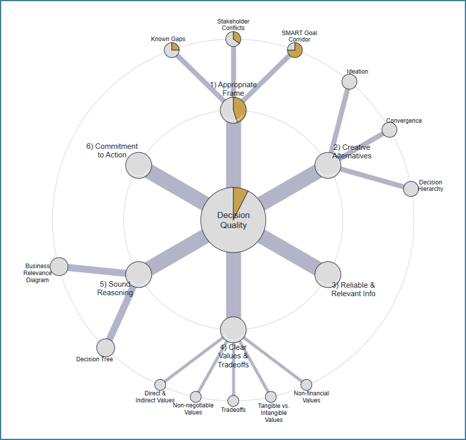
Visual Scoremap — Decision Quality after Phase 1, Frame
Framing: 2.25/5 (45%) — broken down across three sub-dimensions: a five-part goal corridor with named indicators and a shared 2032 deadline was built (75%), though numeric targets are still pending and the set itself is flagged as incomplete; one concrete inter-stakeholder conflict was named (35%), but not a systematic check across all affected groups — that’s Map and Decide’s job; and one gap in the corridor was found through honest self-review (25%) — a search that can, by definition, never claim to be finished. Decision Quality isn’t one number. It’s several distinct sub-skills, and this is what an early, honest pass at just one of them actually looks like.
Information: n/a — systemic data collection begins in the next article. Alternatives / Reasoning / Values & Trade-offs / Commitment: n/a — not yet reached.
© 2026 Dr. Tobias Adam · www.strategic-clarity.site