What You See When You Actually Let Scenarios Disagree
This is the third article in a six-part series on structured decision making, where I work through a real, publicly discussed case — Mallorca’s tourism debate — using my Strategic Clarity framework: Frame, Map, Imagine, Design, Decide, Commit. This piece covers Imagine: building multiple futures to test strategies against later, including one constructed through deliberate scenario stress testing. Methodology notes and context at the end.
In the last article, I worked through how Mallorca’s tourism system appears to connect, based on the mapping I built — fifteen forces, twenty-seven links, four self-reinforcing loops. That’s a structured account, not a verified fact about the system itself, and it described things as they stand, not where they’re going.
Most planning quietly assumes an answer to that anyway. Somewhere between “here’s the situation” and “here’s the strategy,” a single expected future sneaks in — usually the one that looks like today, only more so. Everything gets designed and tested against that one picture, and the picture itself never gets questioned.
Imagine lays the groundwork for both what comes next. It builds a genuinely different set of futures to test everything against, instead of quietly betting on one. And, working from the same map, it derives a potential strategy space — dimensions of choice, each anchored to a real point of leverage — that Design will later develop into actual, distinct intervention ideas. This article works through both, starting with the futures.
What scenario stress testing actually requires
Before any scenario gets built, Imagine doesn’t start from scratch on what could vary — it works from what Map already flagged as consequential: the drivers whose shifts ripple through the rest of the system, out of everything that could conceivably change. Based on that prioritization, I worked from five such factors, each with three genuinely different variants — not shades of the same idea, but different directions the factor could plausibly move in:
| Factor | Variant 1 | Variant 2 | Variant 3 |
|---|---|---|---|
| Climate pressure | Gradual change, summer stays dominant | Faster shift toward a real second season | Abrupt tipping point, summer disrupted |
| Competitive intensity | Diffuse, no clear direction | Converges in Mallorca’s favor | Converges against Mallorca |
| EU regulatory reach | Confirmed local authority | EU unification, tied to policy goals | Erosion of local authority |
| Platform economy | Continued concentration | Regulatory limits, no breakup | Structural restructuring |
| Water-energy coupling | Still tied to fossil energy | Gradual decoupling | Full technological decoupling |
Five factors, three variants each, is 243 theoretically possible combinations. Most of them don’t hold together — a factor pair that contradicts itself once you think it through. Checking every pair against every other pair narrowed that space down to a much smaller set of combinations that are actually internally consistent.
Seven futures, one of them changing nothing on purpose
That narrowing produced seven futures. One of them, deliberately, changes nothing: every factor simply continues on its current path. I call it the comparison anchor. No shock, no reform, no breakthrough — just the current trajectory, carried forward. That sounds like a strange thing to build on purpose. It’s exactly the point. Without an explicit “nothing changes” future named alongside the others, every other scenario gets judged against an unstated, unexamined assumption about what “normal” would have looked like anyway. Naming it removes that blind spot.
The other six are not all covered here in equal depth — two get a full section below, because they turned out to carry the most interesting findings. But naming what the remaining four actually are matters, so the space doesn’t just look like an assertion:
- One combines continued platform disruption with a summer demand boom that never lets up — pressure stays high and concentrated, while the regulatory and distribution architecture underneath it changes fundamentally.
- One is the real decline scenario: competitiveness erodes, EU-level authority erodes with it, and nothing in the system compensates — the most divergent of the seven.
- One trades market share for resilience: Mallorca loses ground to competing destinations, but a genuine technological breakthrough decouples water and energy costs from fossil volatility regardless.
- One pushes demand even higher than the comparison anchor, with competitors weakening further in Mallorca’s favor — while every institutional and technological dimension stays frozen exactly where it is today.
A future that looks like progress, until you check who it’s progress for
One of the seven futures combines two forces pulling the same direction: demand spreading into shoulder seasons, paired with EU-level rules increasingly tying short-term rental rights to sustainability metrics. On paper, this is the “successful redistribution” story — less peak-summer pressure, institutional backing for unpopular measures, real momentum toward Map’s goal (b).
Two findings complicate that story once you look closer. The environmental case turns out to be more conditional than a first read suggests: the evidence this analysis draws on points to a real risk that a longer season can raise total annual visitor volume even as it flattens the summer peak — the same structural risk the water mechanism in Map already flagged, showing up again in a different future built through an entirely different method. And the clearest, most direct winner in this future isn’t who a first pass assumes: seasonal workers. A genuine second season hits their own stated interest — steadier income, better conditions outside the summer crush — more directly than any of the other six futures built. That connection didn’t show up in the first pass through this scenario either. It only appeared once the stakeholder check was run seriously, against what the workers themselves had said mattered to them, not against what seemed obvious from outside.
The Black Swan wasn’t built by making things worse
The seventh future in the set isn’t a plausible combination of the same five factors. It’s something else: a deliberate stress test, built by taking the comparison-anchor future and using an inventive-thinking operator — subtraction — to remove one specific, hidden assumption from it: that climate change stays gradual.
Replace “gradual” with “abrupt” — a sudden, severe heat event compresses years of change into one visible season — while leaving every other factor exactly where the comparison anchor left it: institutions unprepared, energy still fossil-coupled, competition still unfocused. The combination is mildly inconsistent by the model’s own internal check, and that inconsistency isn’t a flaw to fix. It’s the entire construction. A real shock doesn’t arrive because every part of a system degrades in tidy unison. It arrives because one part moves fast while the parts meant to absorb it are still moving at their old, comfortable pace. None of the other six futures can show that. They’re all built to be internally consistent — which is exactly why the danger that lives in the gap between fast and slow was invisible until someone deliberately built a future to expose it.
This isn’t a hypothetical worth dismissing. Summer 2026 was already the hottest on record in Spain, and research into how extreme heat affects returning visitors is already underway — the underlying pressure this scenario stress-tests is not speculative.
What doesn’t get smoothed over
Two disagreements about who wins and who loses in specific futures stayed unresolved on purpose. In one case, whether local government comes out ahead or behind in a scenario built around successful economic growth without institutional reform depends entirely on which of its own internal factions you’re asking — and the honest answer is that it splits, not that one reading quietly wins. I’m not picking a side here that the underlying analysis itself left open. A completeness caveat, same as in the earlier articles: seven futures is a rich space, not an exhaustive one — a sixth factor, cyber and data governance, was deliberately left out of this pass and remains a real gap, not an oversight I’m hiding.
Five dimensions, not yet a strategy
Imagine’s second job, mentioned at the start, ran alongside the futures: working from the same map, five raw building blocks were generated — not finished options, but five dimensions of strategic choice, each anchored to one specific point of leverage in the system. What Design does next is give each of these dimensions its own range of variants, then combine them using the exact same systematic method used above to build the seven futures: dimensions, variants, a consistency check — not a strategy chosen freely, but one derived the same disciplined way the futures were.
What Imagine actually hands off is the five dimensions themselves, not yet their variants:
- How regulation gets enforced.
- How rental capacity gets allocated across the island.
- When a policy response actually triggers.
- What a booking transaction is even for.
- How environmental health gets measured at all.
None of these five were chosen freely. Back in Map, every driver in the system got counted twice — how many others it actively pushes, and how many push back on it — then cross-referenced with which of the four feedback loops it belonged to. That produced seven points of real leverage, split into two different kinds: two hubs, high-traffic and touching almost everything, but hard to move in isolation because the system pushes back just as hard; and five narrower bottlenecks — a delay, a threshold, a single point where a loop can be interrupted directly, easier to steer precisely because they’re less central on paper. Six of those seven leverage points became the five dimensions above (two of them, a delay and its trigger, combined into one). The seventh didn’t make it into a dimension this time: giving the environment its own institutional voice, instead of leaving it represented secondhand by whichever other party happens to raise it. That’s not a decision I’m defending as correct. It’s a gap worth naming, the same kind this series keeps surfacing.
What each dimension’s real range of variants looks like, and which combinations hold together as an actual strategy, is Design’s work, not this one — and the real test after that is holding the result against all seven futures built here, including the one nobody expected to need.
A note on this series: This article is a methodological illustration of my Strategic Clarity framework using Mallorca as a case study — not an evaluation of specific political decisions or actors. This case is offered as a discussion prompt and a working example, not as a complete or authoritative account — Mallorca’s tourism system has more dimensions, affected groups, and open questions than any single analysis, however careful, can fully capture. The scenario space and option impulses used here come from an internal test run of my own Strategic Clarity software, applied to Mallorca’s tourism debate as a demonstration case. There is no real client behind this analysis, and the “consortium” referenced in this analysis is an assumed, illustrative construct built for testing purposes, not a documented position of any real institution. Individual claims are explicitly flagged internally as either evidence-backed or still-to-be-verified assumptions; I’ve carried that distinction through into this article rather than presenting everything with equal confidence. My focus remains the wellbeing of the island and all who inhabit it — human and ecological alike — not party politics.
Decision Quality Radar — Status after this article
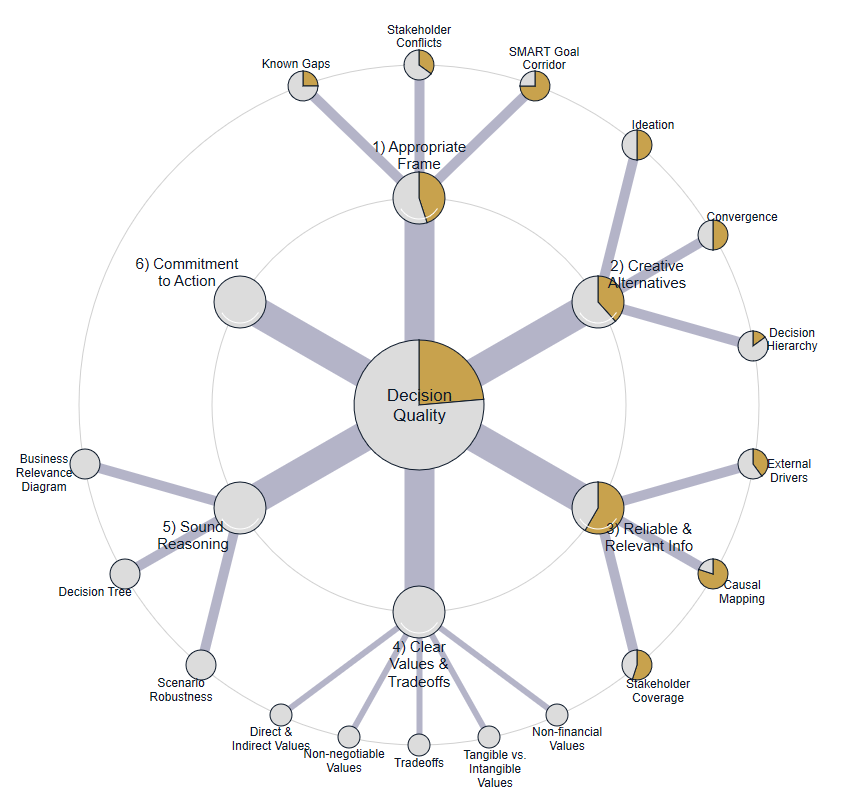
Framing: 2.25/5 (unchanged from Article 1) Information: 2.92/5 (unchanged from Article 2)
Creative Alternatives: 1.75/5 (35%) — broken down across three sub-dimensions, each capped near 50% because this dimension spans two phases: Imagine supplies the scenario half, Design supplies the option-architecture half still to come. Ideation (roughly 45%): generation was thorough within Imagine’s share — seven futures built through the morphological method, five dimensions of choice anchored to real leverage points from Map’s own analysis — but it’s only half the picture until Design adds its own. Convergence (roughly 45%): real narrowing happened for the futures (243 theoretically possible combinations, checked down to seven internally consistent ones); the narrowing of leverage points into five dimensions, though, had already happened back in Map’s active-passive analysis, not fully within this phase. Decision Hierarchy (roughly 15%): partially supported by the SMART goal corridor from Frame, which gives an early basis for prioritization — but the seven futures themselves aren’t options or concepts being structured. They’re test conditions, not material for a hierarchy; treating them as one would double-count the same substance under a different name.
Sound Reasoning: n/a — not yet reached. This case surfaced a genuine gap in how Decision Quality gets assessed across a multi-phase process: a new sub-dimension, Scenario Robustness — whether a decision has actually been checked against the range of futures built here — belongs under Sound Reasoning but can’t be scored until a decision exists to check. First opportunity: Decide.
Values & Trade-offs / Commitment: n/a — not yet reached.
Scenarios start from drivers. The Driver Map in the Starter Kit’s Workshop Canvas is one way to collect yours.
Take the methods with you
The Strategic Clarity Starter Kit gives you four tools from the framework behind these articles: a Self-Assessment, a Cognitive Bias Guide,
a SIT Quick Reference and a Workshop Canvas with templates
for framing, driver mapping and a morphological box. Free.
Working on a specific decision? Talk to me about it →
The book explains how a scenario space is built and why a single expected future is a risky basis for a decision. Chapter 4 (From Drivers to Scenarios) covers the method, and Chapter 6 shows five external scenarios for the Novaria case. Both are in Strategic Clarity in a Fragmented World, available on Amazon.
© 2026 Dr. Tobias Adam · www.strategic-clarity.site