What You See When Every Strategy Option Costs Something Real
This is the fifth article in a six-part series on structured decision making, where I work through a real, publicly discussed case — Mallorca’s tourism debate — using my Strategic Clarity framework: Frame, Map, Imagine, Design, Decide, Commit. This piece covers Decide, the phase where decision quality is put to the test: holding three strategy families against shared criteria and scenarios, and reading the result without adding it up to a single score. Methodology notes and context at the end.
In the last article, I built three complete strategy families for Mallorca: a central and technical one, an incremental and institutional one, and a decentralized and participatory one. They are three theories of change, not one idea in three strengths. Decide now asks what each of them costs.
Decide is the phase in which most people expect a winner. This article doesn’t name one, and the reason lies in the method, not in a gap in it.
The three families, in plain terms
The ratings below only make sense if you can picture what is being rated. Here is what each family amounts to in everyday terms.
| Family | What it does, in plain terms | Who gains most | Who carries the burden | Biggest open risk |
|---|---|---|---|---|
| A: Digital fine-tuning | Steers visitor numbers, enforcement, locations and resources such as water continuously and in fine detail, with data and automated checks. Local co-decision is meant to give it legitimacy. | The environment and scarce resources | Small, locally rooted operators and suppliers, and an administration facing a heavy workload | No known system works this way; all five levers are set to their most ambitious form at once |
| B: Managed continuity | Applies the instruments that already exist — bed caps, periodic checks, one licence type — more consistently. No new technology, no new channel for participation. | Operators with today’s business model (planning certainty) and the administration (least effort) | The environment and the people under pressure today, because the known harm keeps growing | Leaves the central lever, total visitor volume, unused; the documented weakness in enforcement stays |
| C: Spatial-participatory differentiation | Does not cap total visitors directly. It steers where tourism happens, zone by zone, and who co-decides, with automated checks. | Residents in the pressure zones and operators in zones away from housing pressure | Operators and suppliers in the pressure zones, a new inequality by location | Displacement between zones, documented but not quantified; the central lever stays unused here too |
Why I don’t add it up
The obvious move at this point is a scorecard: rate each option on every criterion, weight the criteria, sum up, pick the highest. It feels rigorous. It also hides the one thing this phase exists to show. An option with mediocre values everywhere can beat an option that is outstanding on one dimension and weak on another, and the sum won’t tell you that you traded one for the other. That is where decision quality quietly erodes: the number looks like rigor while the trade-off disappears.
The weights are the second problem. How much does protecting the environment count against legal certainty for the people who carry the risk? That is not a fact I can look up. It is a value judgment, and it belongs to whoever will carry the decision and its consequences. This case has no such person, because it is a test case with no real client. So I stop where the analysis ends and the weighing begins, and I show what the weighing would have to look at.
Decision quality starts with criteria fixed in advance
I set six criteria before rating a single option, each tied to what the earlier phases had found. Three can be rated on a five-point scale. The other three are better told in words, because one number would flatten exactly the tension they are meant to show.
| Criterion | A: Digital fine-tuning | B: Managed continuity | C: Spatial-participatory differentiation |
|---|---|---|---|
| Systemic effectiveness (does it reach the central pressure points: overall volume, housing, resource use?) | 5 of 5 | 1 of 5 | 3 of 5 |
| Legal and implementation certainty | 2 of 5 | 5 of 5 | 3 of 5 |
| Political and administrative feasibility | 2 of 5 | 5 of 5 | 3 of 5 |
| Robustness across scenarios | see next section | see next section | see next section |
| Burden on groups with little voice | strongest protection for resources, heaviest failure risk on the smallest players | favors those who are already powerful | middle position, plus a new inequality by location |
| Ethical balance | lenses divide | four of six lenses point against | no clear direction |
A note on reading the numbers: a 5 means the family meets the criterion very well, a 1 means it meets it very poorly. The scale is ordinal, so a 4 is not twice a 2, and the scores are only meaningful side by side, not as absolute quality. Each rating comes with a written justification in the underlying analysis.
There is no total row. Reading across, no family wins every line, and that is the point.
One thing is missing, and I’d rather say so: none of the six criteria is financial. Costs, revenues and the size of any fund are not part of this comparison. A real project would need that dimension.
Holding the options against seven futures
The seven scenarios from Imagine exist for exactly this. Design ran a first, rough pass. Decide does it properly and weights each result by how well the scenario itself is evidenced. Five of the seven rest on solid evidence. Two still depend on an assumption about competing destinations that I haven’t researched thoroughly, so their results carry that caveat.
Against the five well-evidenced scenarios, family A holds up in four. The exception is a sudden shock that could damage the data infrastructure it relies on. Family B is not clearly robust against any of them, because it largely is the continuation that several scenarios describe. Family C sits in the middle: never clearly weak, and robust without caveats in at most one of the five. One combination, eroding local authority together with structural change in platforms or in the water-energy link, appears in none of the scenarios, so none of the families counts as checked against it. That matters most for A and C, because both rely on binding local co-decision.
A correction to my own last article: I wrote there that robustness can be scored “once a decision exists to check.” More precisely, it needs options that have been evaluated, which is what this phase did. No decision is needed.
Reading the shape, not the area
Seven axes capture the tensions: systemic effectiveness, robustness across scenarios, legal and implementation certainty, protection of the environment and of future generations, protection of today’s small and hard-to-see players, feasibility, and degree of participation. I plotted each family on a five-point scale.
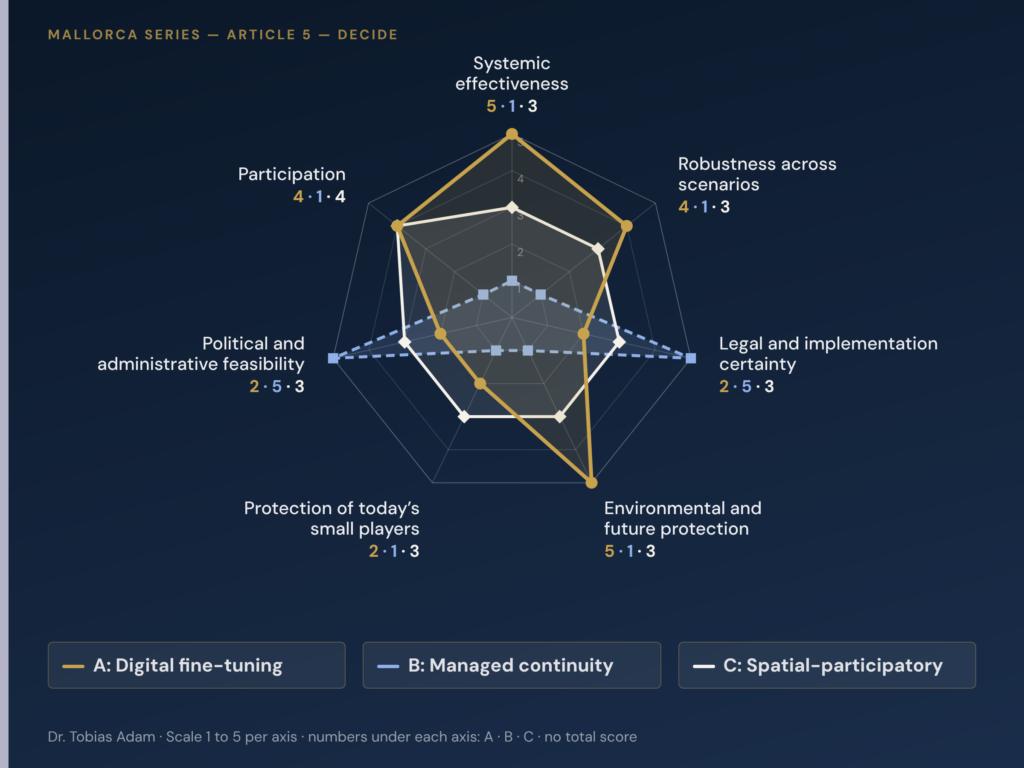
The result is a shape, not a number. Family A reaches 5 on environmental and future protection and sits at 2 on protecting today’s small, hard-to-see players. I placed those two axes next to each other so that the sharpest contrast shows as a spike. Family B is the mirror image: 5 on legal certainty and on feasibility, and the lowest value on five of the seven axes. Family C sits in the middle on most axes, with a 4 on participation, like A.
The area under each line would suggest that one family is “bigger” than another. It says nothing of the sort. What matters is what each shape gives up. A gives up legal certainty, feasibility and protection of the smallest players to gain effectiveness and protection of the environment and the future. B gives up effectiveness, robustness, environmental protection, protection of small players and participation to gain legal certainty and feasibility. C gives up the sharpest answers on either side to gain a middle position. No fourth combination avoids this, because the consistency rules from Design leave only a limited number of workable packages.
A limit is not a trade-off
One thing I kept out of the weighing on purpose. Planetary boundaries, the ecological limits within which any option has to work, are not one more criterion to be traded against the others. A boundary is crossed or it isn’t. So I treated them as a guardrail beside the criteria.
Checked that way, one gap affects all three families equally. All three steer resources such as water and energy to some degree, but none of them addresses nautical leisure traffic and anchoring. That matters because anchors damage Posidonia meadows, seagrass that regrows only slowly: a 2023 mapping study reports that in some parts of the Balearic Islands up to 40 percent of the meadows have disappeared, mainly due to damage from the anchors of recreational boats (del Valle Villalonga et al., Remote Sensing, 2023). This is one example, not the only limit that matters for the island. The point is what a guardrail does: it shows what the options leave out, which a criterion that can be traded away would not.
Whether any of the three families would stay within the limits, I can’t say: no threshold has been quantified, so this stays open. The guardrail is the closest this analysis comes to giving the environment a voice, which was still missing at the end of Design.
Six ethical lenses, no verdict
Setting weights is a value judgment, so I did not want the values behind it to stay implicit. Alongside the evaluation, a separate check read each family through six ethical lenses. Each lens asks a different question, and the same option can look very different through each of them:
| Lens | The question it asks |
|---|---|
| Consequences | Which option leads to the best overall outcomes for everyone affected? |
| Duties and rights | Does the option respect rights and obligations, whatever the outcome? |
| Fairness toward the least advantaged | Does it leave the people with the least power and the fewest resources better or worse off? |
| Character and prudence | Is it a wise, cautious way to act under uncertainty? |
| Care for the vulnerable | Does it protect those who depend on others and cannot easily protect themselves? |
| Fairness between generations | Does it pass on a fair share of options and resources to those who come after us? |
The lenses are not votes to be counted. They show where the values sit, so that the weighing, once someone does it, is done in the open.
Two things stand out. Four of the six lenses independently point against family B: it protects those who are already powerful and leaves those with little influence, and the generations to come, with a harm that grows over time. Against that stands a real but weaker argument, that avoiding untested mechanisms is prudent. For A and C, the lenses divide. A looks strongest through consequences, care for the vulnerable and fairness between generations, and riskiest through duties and rights, fairness toward the least advantaged and prudence, because its legal protections still exist only on paper and the risk of failure falls on the smallest players. C sits between, and one lens, fairness toward the least advantaged, reads it in two opposite ways.
I did not resolve these divergences. Resolving them would mean deciding which value outweighs which, and that is exactly the decision that belongs to someone else.
What a preference looks like without a verdict
A reader might fairly ask: if you won’t name a winner, can you say anything about preference? Yes, as a condition.
- If protecting the environment and future generations outweighs legal certainty and the burden on small players, family A follows. The price: legal protection that is not yet tested, and a risk of failure concentrated on the smallest.
- If avoiding new, untested risks outweighs the continuation of a known, worsening harm, family B follows. The price: the harm continues, and the most central lever stays unused.
- If decentralization and participation matter more than treating every place alike, family C follows. The price: a new inequality by location, and a displacement effect between zones that nobody has quantified.
The order is not a ranking. All three positions are legitimate, but not equally well supported: B carries the strongest convergence against it and the weakest robustness.
This is what a decision looks like once it is no longer black and white. It is not a point on a line but a position that depends on weights, and a price you can name before you choose.
What this evaluation cannot see
Three limits I’d rather state than hide. Any evaluation can only weigh the groups it knows about; if someone was missing from the picture when the criteria were set, no criterion recovers them afterwards. The legal questions around automated enforcement are named but not settled. And two of the seven scenarios still rest on an assumption I haven’t researched thoroughly.
Four questions to test the decision quality of your own choice
If you want to try this on a decision of your own, four questions do most of the work:
- Did you write down your criteria before you looked at the options?
- For each option, can you finish the sentence “By choosing this, I accept ___ in order to gain ___”?
- Is there a limit that is not up for trading, and have you kept it out of the weighing?
- Whose interests are affected, including people who are not in the room, and where do they show up in your criteria?
And if a total score is tempting, ask who set the weights.
Decide hands over no winner. It passes on three options with their prices stated, a guardrail kept outside the weighing, and a clear view of where the weighing belongs: with the person who will carry the decision. Turning one of them into a commitment, and facing its weak spots, is the next phase’s work.
Source: del Valle Villalonga, Pons and Bardolet, Posidonia oceanica Cartography and Evolution of the Balearic Sea, Remote Sensing 15(24), 2023.
A note on this series: This article is a methodological illustration of my Strategic Clarity framework using Mallorca as a case study — not an evaluation of specific political decisions or actors. This case is offered as a discussion prompt and a working example, not as a complete or authoritative account — Mallorca’s tourism system has more dimensions, affected groups, and open questions than any single analysis, however careful, can fully capture. The criteria, ratings, scenario assessment, radar and ethical check used here come from an internal test run of my own Strategic Clarity software, applied to Mallorca’s tourism debate as a demonstration case. The figure on Posidonia meadow loss is my own editorial addition, drawn from a 2023 study as of October 2026, and was not part of the software’s output. There is no real client behind this analysis, and the “consortium” referenced in this analysis is an assumed, illustrative construct built for testing purposes, not a documented position of any real institution. Individual claims are explicitly flagged internally as either evidence-backed or still-to-be-verified assumptions; I’ve carried that distinction through into this article rather than presenting everything with equal confidence. Parts of the analysis are produced with the support of AI agents and reviewed editorially before publication. My focus remains the wellbeing of the island and all who inhabit it — human and ecological alike — not party politics.
Decision Quality Radar — Status after this article (Visual Scoremap)
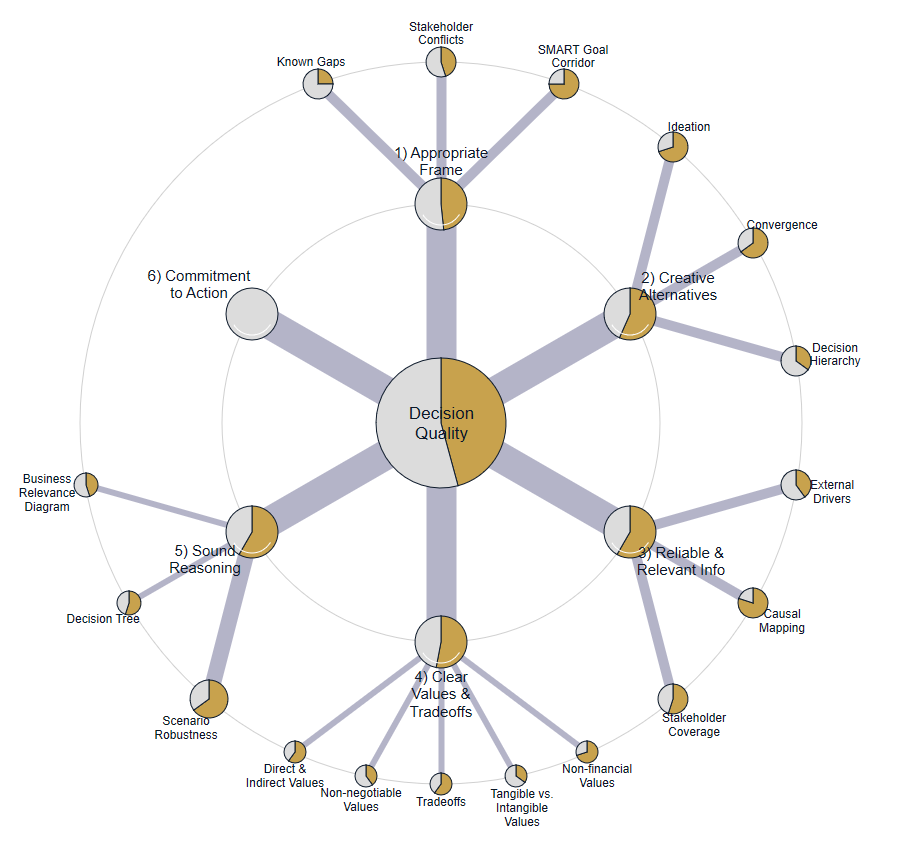
Framing: 2.25/5 (unchanged from Article 1). Information: 2.92/5 (unchanged from Article 2). Creative Alternatives: 2.83/5 (unchanged from Article 4).
Values & Trade-offs: 2.65/5 (53%), scored for the first time. Direct and indirect values (roughly 60%): six criteria were fixed before any option was rated, covering direct effects and effects on groups with little voice; held back because they were derived without anyone who carries the decision, and indirect effects are named, not quantified. Non-negotiable values (roughly 40%): the guardrail keeps limits out of the weighing; held back because no threshold is quantified and no family was tested against one. Trade-offs (roughly 60%): each family has an explicit “accept X to gain Y” statement, plus one across families; held back because exchange rates, time preferences and probabilities need someone to set them. Tangible versus intangible values (roughly 35%): the comparison contains no financial dimension. Non-financial values (roughly 70%): ethical lenses, burdens on groups with little voice and legitimacy are covered in depth; held back because nobody has weighed them against each other.
Sound Reasoning: 2.75/5 (55%), scored for the first time, as the average of its three sub-nodes. Scenario robustness (roughly 65%): each family was tested against seven futures, weighted by how solid the evidence for each future is, with open points stated, such as a combination no scenario covers; held back by qualitative ratings instead of a model, and by two scenarios that rest on an unresearched assumption. Decision tree (roughly 55%): the if-then structure of the conditional preference lays out the branches; held back because no probabilities or payoffs are assigned. Business relevance diagram (roughly 45%): criteria and radar show which effects matter for whom; held back because there is no client whose goals the options could be translated into.
Commitment to Action: n/a — not yet reached.
The Workshop Canvas in the Starter Kit includes an Evaluation Matrix template for laying out your own options against criteria you have fixed in advance.
Take the methods with you
The Strategic Clarity Starter Kit gives you four tools from the framework behind these articles: a Self-Assessment, a Cognitive Bias Guide,
a SIT Quick Reference and a Workshop Canvas with templates
for framing, driver mapping and a morphological box. Free.
Working on a specific decision? Talk to me about it →
The book treats evaluation as a core step. Chapter 4 (Evaluate with Decision Quality) tests options for feasibility, impact and robustness, and the Novaria case in Chapter 6 (Decide: Choosing and Committing) works through criteria, robustness and trade-offs without reducing them to a single score. Both are in Strategic Clarity in a Fragmented World, available on Amazon.
© 2026 Dr. Tobias Adam · www.strategic-clarity.site